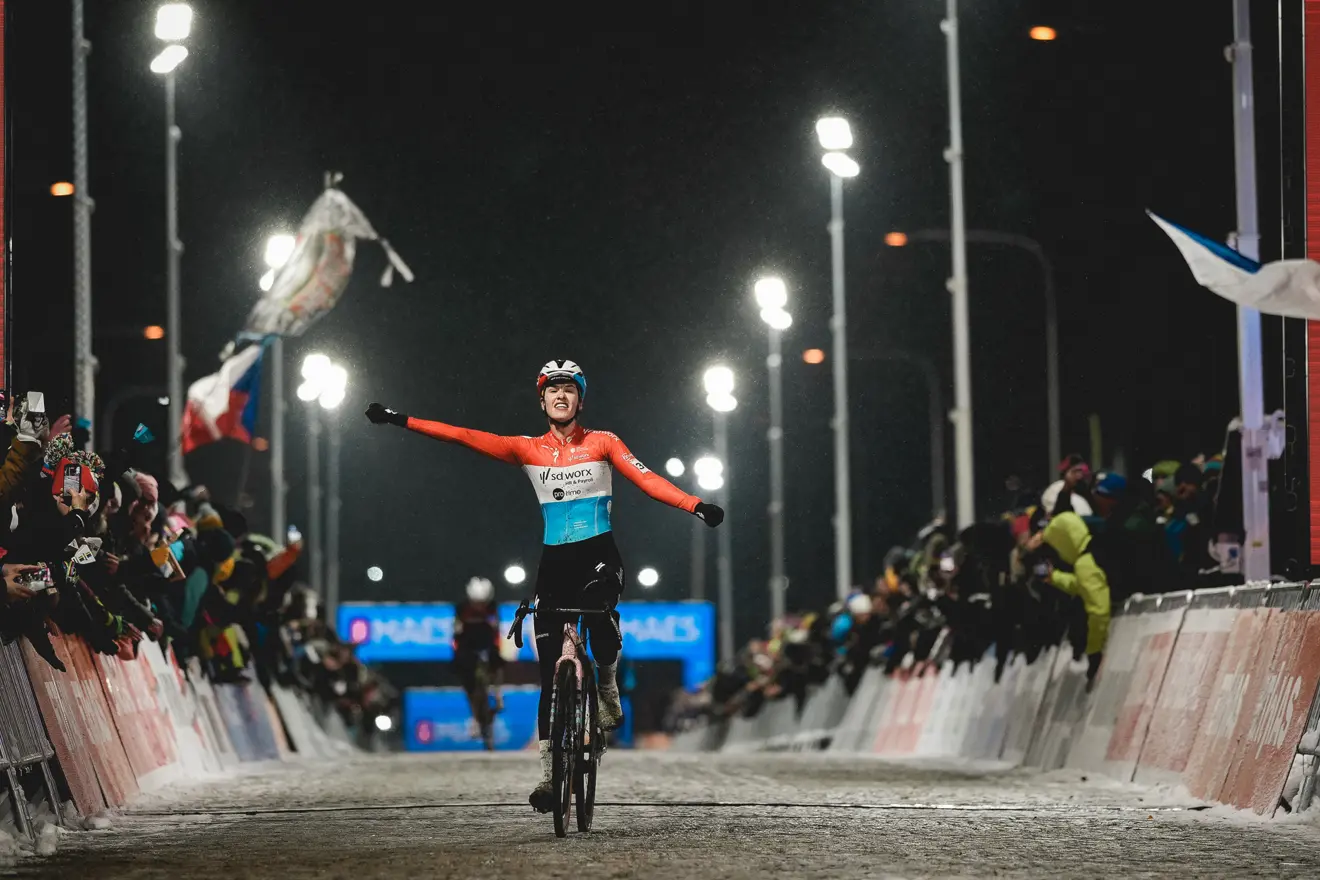
On Friday, 27 November, the most prestigious series in cyclocross — the World Cup — got under way in the Czech city of Ostrava. It was no ordinary season opener: a night race under floodlights on a snow-covered course. Cross like this has a magic of its own. On a white course every corner tests the tyres, the balance and the nerves, and by the barriers you can see the riders’ breath hanging in the light.
What is cyclocross?
Cyclocross is cycling’s autumn and winter discipline. Riders lap a short circuit of 2.5 to 3.5 kilometres many times over: tarmac, grass, woodland trails, sand, steep banks and obstacles. Where the bike can’t be ridden, the rider jumps off, shoulders it and runs. A rider running up a muddy bank with a bike on their shoulder is the sport’s best-known image.
A race lasts about an hour, and there is nowhere to hide. Speeds are far lower than on the road, so sitting on someone’s wheel saves you very little. Power, stamina and bike handling decide everything. Riders may change bikes during a race: while they are out on the course on one, their mechanics wash and fix the other. On a muddy day that becomes a show of its own.
The heartland of cyclocross is Belgium — Flanders above all — along with the Netherlands and France.
A little history
There are several legends about how cyclocross was born. One has it that in the early 1900s road racers spent the winter racing each other to the next town, and any shortcut was allowed: fields, fences, ditches. Often their only landmark was the next town’s church steeple. It kept them fit through the winter and sharpened their bike handling.
The Frenchman Daniel Gousseau is regarded as the sport’s founder; in 1902 he organised the first French championship. Géo Lefèvre, the man who came up with the idea of the Tour de France, also helped the young sport along. In 1910 Octave Lapize won the Tour and credited his winter cyclocross training, and that same year Belgium held its first national championship — cyclocross had crossed France’s borders.
In 1924 Paris hosted the first international race, regarded as an unofficial world championship. The UCI created the official World Championships in 1950, again in Paris, and the first champion was Jean Robic, winner of the 1947 Tour de France. The women’s world championship arrived only in 2000; its first winner was Germany’s Hanka Kupfernagel.
Today the record belongs to two Dutch riders: Marianne Vos has eight elite world titles among the women, and Mathieu van der Poel has eight among the men — he won the eighth this February in Hulst.
The World Cup
The World Cup was founded in the 1993–94 season, and this is its 34th edition. Unlike the World Championships, a one-day race, the World Cup runs all winter: this season it has 12 rounds in six countries, from Ostrava (27 November) to Hoogerheide (24 January). It is organised by the UCI and Flanders Classics, and the leader of the standings wears the white-and-red jersey.
A season that began without the big names
In recent years three names have defined cyclocross: Mathieu van der Poel, Wout van Aert and Tom Pidcock. This year all three were missing from the start. Van der Poel, the reigning world champion, hasn’t made up his mind: “I don’t know if there will be a comeback in the field, so we’ll see.” Van Aert will be back, but with a short programme; he is expected around Christmas, and his main goal is the World Championships in Ostend at the end of January. Pidcock won’t race cyclocross at all this winter.
Until the big names arrive, the stage belongs to others. Among the men the strongest so far has been Thibau Nys: he became European champion in Zeddam, won all three X²O Trofee races, and at the Koppenbergcross he crashed twice and still came home first. The Superprestige tells a very different story: four races, four different winners — Michael Vanthourenhout, Joran Wyseure, Cameron Mason and Niels Vandeputte.
Lucinda’s autumn
Among the women, the face of the season was already clear: Lucinda Brand. In February the Dutchwoman won her second world title in Hulst, and in November she became European champion in Zeddam as well — and dramatically so. Luxembourg’s Marie Schreiber crossed the line first, but the jury relegated her to second for deviating from her line in the sprint. Add to that wins in Overijse, at the Koppenberg, in Hamme and in Merksplas.
Five days before Ostrava, in Beringen, Lucinda slid off the course on the penultimate lap and went down. She still finished second, with a sore rib. Italy’s Sara Casasola beat her that day — her second win in two days — and closed to within 41 seconds of Lucinda in the X²O standings.
Ostrava: the women
The favourites were Lucinda Brand and Sara Casasola, but the winner was someone very few had tipped. Aniek van Alphen went clear early and led alone for a long time, but on the fifth lap her chasers, Marie Schreiber and Manon Bakker — who had crashed on the very first lap — caught her. On the final lap Schreiber didn’t wait for a sprint: she attacked and crossed the line alone. It was the second World Cup win of her career. In Zeddam, at the European Championships, it was a sprint that had cost her the gold. Van Alphen took second, six seconds back, with Bakker third at nine seconds.
“At the first part, I had some problems with [my] pedals, like everyone did, it was really hard to clip in, but then I changed bikes and it was better,” Schreiber said after her win.
The snow was more than scenery that evening. The racing line packed down in the frost and became fast, but there was snow lying in the pit lane. Cleats refused to click into pedals, so the race was decided not just by power but by who changed bikes, and when. Bakker’s start bike had a problem; in the fight for the win Van Alphen was stamping on her pedal to knock the snow out of her cleat. She still called the race “fun”.
Nobody suffered more than Lucinda. On the third lap she spent a long time in the pit: her mechanics sprayed antifreeze on her pedals, and she swapped bikes and goggles. That lap took her 8 minutes 21 seconds, almost a minute slower than normal — and she rode the next one in 7:14, one of the fastest laps of the race. After that she couldn’t hold the pace and finished 15th, 2:25 down. “I think everybody struggled with their pedals, I couldn’t clip in at all,” she said. The Beringen rib, it seems, had nothing to do with it.
Fourth went to Britain’s Zoe Bäckstedt, whose 7:01 final lap was the fastest of the day. Local rider Kristýna Zemanová gave the home crowd sixth place.
On the podium the women were shivering with cold — and smiling. Schreiber pulled on the World Cup leader’s white-and-red jersey and threw her bouquet to the fans. She makes no secret of her goal: the overall World Cup title.
Ostrava: the men
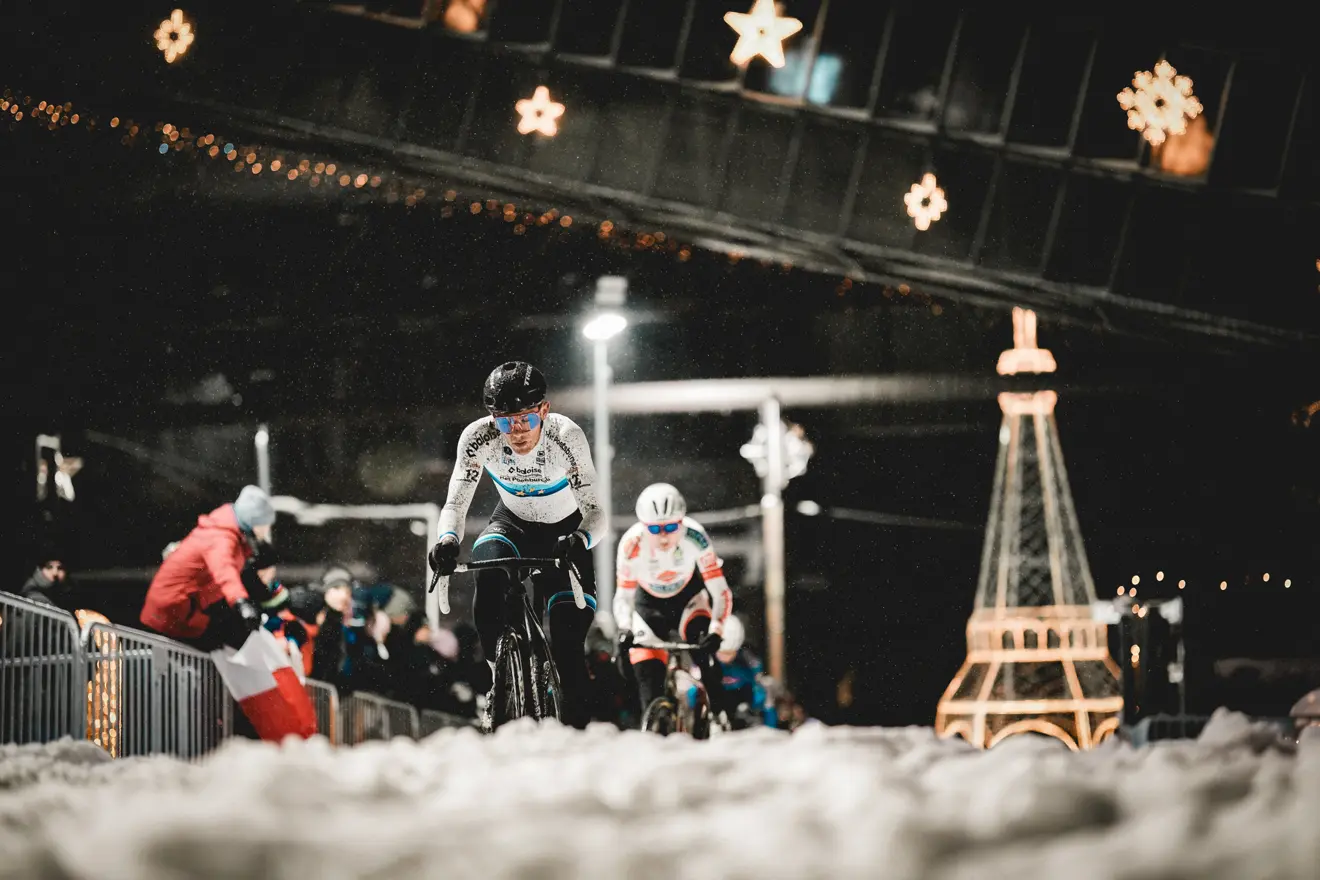
Thibau Nys in the Ostrava snow. Photo: © Flanders Classics
Thibau Nys rode the race like a chess grandmaster. He had two flat tyres and even had to stop to clear his cleat, and all that cost him plenty of strength — yet he didn’t waste a single ounce of energy. In our view, that is where he beat his rivals: in the middle of the race Del Grosso and Vanthourenhout kept taking turns at the front, trying to break the group, and when that didn’t work, they never changed tactics. On the final lap he took command: he passed Tibor Del Grosso before the last set of stairs and broke clear 200 metres from the line. Del Grosso, who had said before the start that his only goal was to reach the finish, barely stayed upright in the slippery corner right before it, and missed out on victory by two seconds. It was Nys’s fifth straight win of the season. “I think it’s in my top three of most beautiful cyclo-cross victories,” he said.
The men set off at minus one degree in fresh snow, and the race stayed together in one big group almost to the end: on the fifth lap ten riders were within five seconds. The Pauwels Sauzen trio — Vanthourenhout, Gerben Kuypers and Yordi Corsus — appeared to be working the race as a team for a long time, but only Vanthourenhout made the podium, in third.
Cameron Mason finished fourth. Before the start the Scot said everyone should be happy about the snow — and at the end he closed on the leaders seemingly out of nowhere, finishing five seconds behind the winner. Sixth place went to Felipe Orts. The Spaniard comes from Villajoyosa on the Mediterranean coast, where you hardly ever see snow — yet in the snow he matched the Belgians for the whole race.
Next stop: Tábor
On Sunday, 29 November, the World Cup continues in the Czech Republic, in Tábor. Schreiber will start in the leader’s jersey, Lucinda will be looking for revenge, and Nys for a sixth straight win. Wout van Aert will turn up around Christmas, while Mathieu van der Poel is still thinking it over. The season is only just beginning.
Photos: © Flanders Classics
Prepared under the editorial vision and direction of Velorbola, with the assistance of AI (Claude by Anthropic). Facts verified; final text by the editors. Translated from Georgian.

In history, only three riders have won all five Monuments: [...]
April 15, 2019