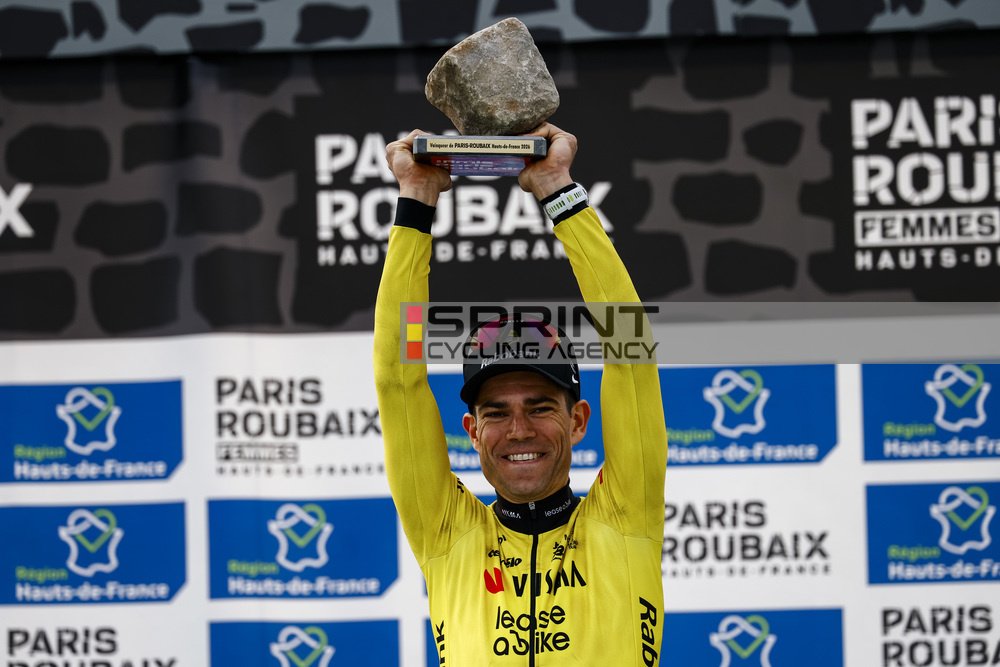
Wout van Aert’s career without the Roubaix cobblestone would have been a great injustice. On April 12, at the 123rd Paris-Roubaix, that injustice was put right: the Belgian beat world champion Tadej Pogačar in a two-man sprint in the Roubaix velodrome. Seven months have passed and I still can’t get this race out of my head. That is why I’m calling it the event of the year.
A family matter
To truly understand what kind of event we are dealing with, you have to feel the history of great cycling and its spirit. What has been happening for more than a century shouldn’t be just a show for you, and the riders shouldn’t be strangers. You should see it as a family. An example? All right… When some daredevil throws himself down a descent so fast that you stop breathing, you should feel it as if he were your own child, knowing that one tiny mistake could cost him his life. That is how you should live it: rejoice and worry, be a part of it. A distant, small part, but a part nonetheless.
That’s one. Two: you need to know the road Wout has traveled. It is full of great triumphs and no smaller injuries. And when a rider who has fallen and come back so many times wins a race like this, I know that even if you are not his fan, you will be glad.
Our own family album starts in 2018. That spring, writing about Peter Sagan’s first Roubaix here on Velorbola, we opened with sad news: during the race, on the Briastre sector, the 23-year-old Belgian Michael Goolaerts suffered a cardiac arrest and later died in hospital. Michael was Wout’s teammate at Vérandas Willems, and it was Wout’s first Roubaix.
Then came second place in 2022 and third in 2023, when a puncture on the Carrefour de l’Arbre struck at the decisive moment. In 2024 he crashed at Dwars door Vlaanderen, broke his collarbone and ribs, and missed the entire cobbled spring. Later that year at the Vuelta, leading two classifications, he left the race with a knee injury. With a record like that, the Hell of the North seemed to be laughing at him.
A shower of stars at the start
175 riders rolled out of Compiègne with 258.3 kilometers and 30 cobbled sectors ahead of them, 54.8 kilometers of pavé in total. The list of favorites was enough to keep the bookmakers awake at night.
Pogačar, in the rainbow jersey, needed Roubaix to complete the set of all five Monuments and join Rik Van Looy, Eddy Merckx and Roger De Vlaeminck. Mathieu van der Poel came for a fourth cobblestone in a row. Alongside them were Mads Pedersen, Filippo Ganna, fresh from winning Dwars door Vlaanderen, Jasper Philipsen, and Wout’s teammate Christophe Laporte. The organizers expected one of two scripts: either Pogačar completes his collection, or Van der Poel takes the stone for the fourth time. Wout was in neither of them.
Pippo’s puncture epidemic
The 2026 edition turned out to be the fastest Paris-Roubaix ever, at an average of 48.91 km/h. At that speed the cobbles show no mercy to tires, and that day they showed none. Filippo Ganna suffered most. After Arenberg, Pippo fought his way back to the leading group, and at that very moment, 82 kilometers from the finish, he punctured. He chased again, and with 50 kilometers to go came another puncture and a crash. As his team put it, the punctures came at the key moments. He finished 25th, 7:32 down. Ask Pippo’s tires and they’ll tell you the race was held not on cobbles but on hedgehogs.
The epidemic spared no one. After the finish Pogačar said he had three punctures and three bike changes. With 121 kilometers to go, on the Quérénaing à Maing sector, he was left alone on a neutral service bike, a minute down, until three teammates brought him back. Wout punctured twice too: first just before Briastre, where Michael fell eight years earlier, then on Warlaing à Brillon.
Mathieu’s incredible comeback
But Arenberg cost Van der Poel the most. He punctured in the forest, the team car was nowhere to be seen, and he took Jasper Philipsen’s bike, whose pedals didn’t fit his shoes. A few meters later he got off, took a wheel from Tibor del Grosso, went back to his own bike, and punctured again at the exit of the sector. He left Arenberg more than two minutes behind. “My race was over in Arenberg,” he said later.
Almost a hundred kilometers to go, two minutes, and the two strongest riders in the world up the road. Still, he chased as if he didn’t believe it. By the Carrefour de l’Arbre he had closed to 25 seconds. He summed it up drily: it’s a bit unbelievable that he still made the sprint for the podium.
The chasers and Jasper’s instinct
On Mons-en-Pévèle, Laurence Pithie crashed out of contention. The final chase group came down to Van der Poel, Pedersen, Laporte, Stefan Bissegger, Mick van Dijke and Jasper Stuyven. Laporte did all the way what a good teammate does: he disrupted the chase. In Stuyven’s words, he was “annoying, in a correct way.”
Three kilometers from the finish, Stuyven attacked. He knew a podium would be far harder in a sprint against Van der Poel and Pedersen. He says he went “on pure instinct,” at a spot where many winning attacks have started in the past. He gained a few meters, and that was enough. Third place, 13 seconds down: his first Roubaix podium. Van der Poel was fourth, Laporte fifth.
Fate has a sense of humor. In March 2024, at Dwars door Vlaanderen, Wout and Jasper went down in the very same crash. Both broke their collarbones, and both ended up on the operating table in the same days. Two years later they stood together on the Roubaix podium.
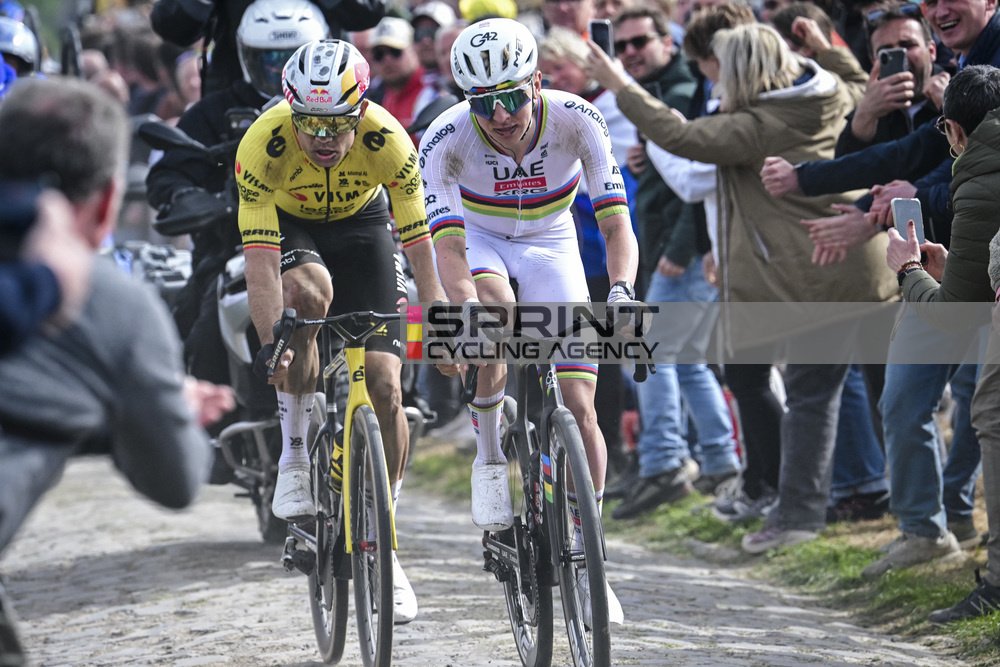
Photo: © Sprint Cycling Agency (BettiniPhoto) / POOL Bernard Papon, provided in support of the promotion of cycling in Georgia
Pogi and Wout
On the Auchy à Bersée sector, 54 kilometers from the finish, Wout attacked. Pogačar went with him at once, and Pedersen fell just short. From then on, the two were time and again within arm’s reach of each other. Pogačar tried to shake him on Mons-en-Pévèle and again on the Carrefour de l’Arbre, but Wout wouldn’t let go. “That was when I knew: stay on the wheel,” he said later. He also admitted that in one corner he understood for a moment why Tadej is the strongest man in the peloton.
Both had their troubles getting there, and both had the cobbles in their legs. Pogačar later admitted frankly that he was “a little bit cooked” and had no freshness left to drop him on the cobbles. Wout was testing his own limits so often that, after the finish, he said the hardest part was reaching the velodrome.
A drained Pogi on the Roubaix oval
They entered the André Pétrieux velodrome together. Wout wanted to come onto the track in second place, and so he did. In the final kilometer, in his own words, he was no longer nervous, and everything felt slow. He launched his sprint around 200 meters out, from Pogačar’s wheel. Tadej tried to respond, but, as he put it, his legs were “just like spaghetti.” That is probably the most Italian excuse a Slovenian has ever offered.
Van Aert lay on the grass in the middle of the velodrome and cried. He pointed a finger to the sky. “This win is for Michael, but also for his family, the staff and everyone at Veranda’s Willems, my former team,” he said. He added that he had stopped believing many times, but every time he woke up the next day feeling it was possible. Van der Poel came straight over to congratulate him. “After all the setbacks he had, of course, it’s nice for him to win,” Mathieu said. Wout said that gesture meant a great deal to him.
The peak of a career
It was Wout’s first Monument since Milan-San Remo in 2020, and his first cobbled one. He will probably win plenty more, but nothing will overshadow this day. The stone he fought for over eight years is finally his.
A last word on Pogačar: he has come to Roubaix twice and finished second both times. In my view, that story isn’t over.
April 12 was a day of great justice: Wout van Aert conquered Roubaix. In a family, days like that are never forgotten.
Featured image: © Sprint Cycling Agency (BettiniPhoto) / Luca Bettini. Photos provided in support of the promotion of cycling in Georgia — sprintcyclingagency.com
Special thanks to Luca and Roberto Bettini for permission to use their photos in our publications.
Prepared under the editorial vision and direction of Velorbola, with the assistance of AI (Claude by Anthropic). Facts verified; final text by the editors.
Translated from Georgian with the assistance of Claude (Anthropic), reviewed by the Velorbola editors.

In history, only three riders have won all five Monuments: [...]
April 15, 2019