The Olympic road race can’t help but be special: a rider may get to race for his country only a few times in his career. Making the national team depends on countless factors, and the chance of them all coinciding is so small that I’ve heard a top star of the world peloton say he was ready to do any job in any tactical plan, as long as he was picked for the team.
The size of the national team varies: how many riders a country will have in the race depends on the achievements of its riders and the rankings earned from them. It’s not that rare for a rider to contribute hugely to his country’s ranking and still miss the team, because on a course of that profile he simply doesn’t fit any of the coaching staff’s tactical plans.
A look at the list of Olympic champions of the new era shows how great the motivation among riders is: you won’t find a single accidental winner here — every one of them has left a significant mark on the great history of professional cycling:
1988 – Olaf Ludwig (GDR)
1992 – Fabio Casartelli (Italy)
1996 – Pascal Richard (Switzerland)
2000 – Jan Ullrich (Germany)
2004 – Paolo Bettini (Italy)
2008 – Samuel Sánchez (Spain)
2012 – Alexander Vinokourov (Kazakhstan)
The Olympic race doesn’t start on the road itself but much earlier — its origins lie in the process of designing the route. The host country will always try to lay out a route that gives its own riders a better chance. That is always the case when the Olympics are held in a cycling nation. This year was different. The Brazilians don’t have top-class riders, so their goal was to make the race’s drama as intense as possible. The course profile ruled out the specialist sprinters from the start, so we wouldn’t see any of them in the Olympic peloton. Nor would we rate the pure climbers’ chances highly, because the sprinter-killing climb and the fast descent were followed by roughly ten kilometers of flat (a so-called shelf) to the finish, where a lightweight climber can easily be caught by a rider with a good individual pace (a tempo rider). So in the leading nations’ teams we saw classics riders who hold up well on climbs, and the bigs (the stars who fight for the general classification in Grand Tours). The presence in Rio’s Olympic peloton of this year’s Tour de France winner Christopher Froome among the British, and this year’s Giro winner Vincenzo Nibali among the Italians, along with other stars, made it clear that the Olympic race was destined to become one of the most intense and interesting in history — but what happened exceeded every expectation.
The race went the classic way: a stabilizing breakaway formed, which the favorites’ teams kept at a comfortable distance. Before the final climb the group came back together; the Italians’ well-thought-out tactical plan stood out in particular.
They took an active part in stabilizing the race in its middle part and in keeping the pace high in the final phase, so that nobody would feel like making surprise attacks. That’s how the Squadra Azzurra arrived at the last climb, where they set a high pace for the leading group.
The aim of the pace was selection: as a result of this selection, the classics riders with a sharp finish who hold up on climbs were not supposed to be in the group when the medals were decided; Damiano Caruso was especially prominent at this point.
On the final climb, in the leading group, Belgium’s Greg Van Avermaet and Britain’s Geraint Thomas were clearly noticeable. Anyone who knows today’s WorldTour peloton would surely say at that moment that if the all-round climbers didn’t shake Greg and Geraint off on the climb and reached the final kilometer with them, it would mean handing one of them the gold medal. At such moments the members of the leading group make their choice based on their teams’ situation and the state of the race at that point. If they have a teammate in the next group who is a real contender and couldn’t hold on up the climb, they stop working and try to slow the pace and wait for the chasers. If they don’t, and their own chances are slim, they still stop taking part in keeping the pace. If they see a good probability, they attack, to shake off riders like Greg and Geraint by at least a few dozen seconds and leave them out of the medal fight.

6 August 2016
2016 Summer Olympics (Rio de Janeiro, BRAZIL)
Road Men
NIBALI Vincenzo (ITA) Astana
Photo : Yuzuru SUNADA
That’s what the legendary Lo Squalo (Vincenzo Nibali, the Shark, winner of all three Grand Tours in his career) did: on the last section of the climb Vincenzo attacked sharply and achieved his goal, dropping the classics riders.
His pace was later answered by the climbers, Colombia’s Sergio Henao and Poland’s Rafał Majka. At the end of the climb a leading group formed that had a fairly significant lead, and if they worked together these riders would contest the Olympic medals. Of the three, Vincenzo Nibali was the clear favorite.

6 August 2016
2016 Summer Olympics (Rio de Janeiro, BRAZIL)
Road Men
NIBALI Vincenzo (ITA) Astana
Photo : Yuzuru SUNADA
The final descent began. It’s no secret to anyone that Vincenzo is one of the peloton’s outstanding descenders, and he also has a serious individual pace in his arsenal, so most specialists considered him the undisputed contender at that moment. They did — until shocking footage appeared. Because the number of camera motorbikes on the descent was limited for safety, the leaders were out of shot for a few seconds, and when the camera came out of the next bend we saw Vincenzo and Sergio on the asphalt. Both had descended all-out; Rafał was behind them, and the camera was apparently following Rafał. The Pole had enough distance to avoid the fallen riders and carried on racing; he was now the sole leader, more than ten seconds ahead of the chasers — ten seconds and ten kilometers. For Rafał, given his specialization, that’s impossible. Meanwhile the chasing group took heart, and seconds later we also saw Geraint Thomas, who had crashed on the same descent. It took seconds to recover from the shock, and the main question arose: where is Greg?

6 August 2016
2016 Summer Olympics (Rio de Janeiro, BRAZIL)
Road Men
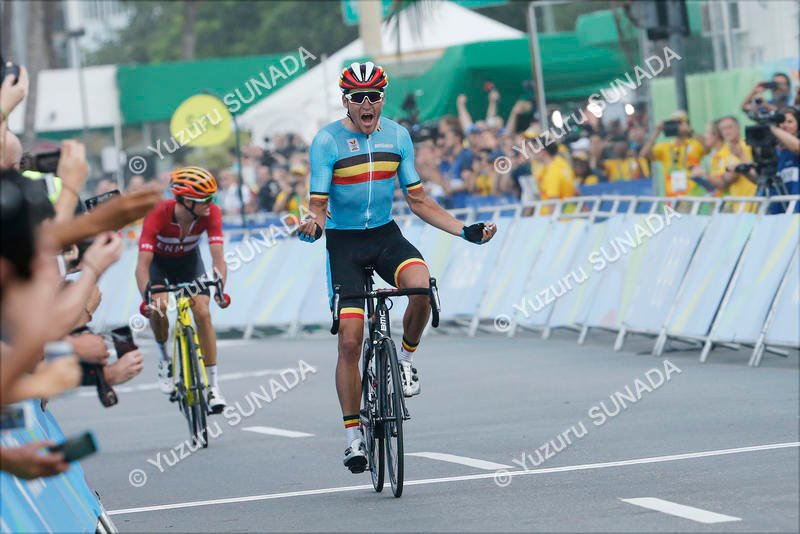
1st : VAN AVERMAET Greg (BEL) BMC
Photo : Yuzuru SUNADA
Greg was among the chasers. Alone, Rafał couldn’t possibly keep his lead; of course he did his utmost, but there are no miracles in cycling — especially when the chasers cooperate. Such an agreement was clearly reached by Greg Van Avermaet and Denmark’s Jakob Fuglsang. Why Jakob? It was his only chance of a medal. Greg and Jakob attacked and then held the pace; before the finish they caught Rafał, and the fate of the medals was decided. Rafał, as riders say, had nothing left in his legs, and Jakob, you could say, doesn’t have Greg’s flat finishing sprint, so the places were distributed like this:

6 August 2016
2016 Summer Olympics (Rio de Janeiro, BRAZIL)
Road Men
1st : VAN AVERMAET Greg (BEL) BMC
2nd : FUGLSANG Jakob (DEN) Astana
3rd : MAJKA Rafal (POL) Tinkoff
Photo : Yuzuru SUNADA
- Greg Van Avermaet (Belgium)
- Jakob Fuglsang (Denmark)
- Rafał Majka (Poland)
And so the very strong Belgian came away with the biggest win of his career!
The next day the women’s race followed a similar script. The difference was that on the last descent the horrifying crash of the leading Dutchwoman, Annemiek van Vleuten, was caught on camera. She lay motionless for two and a half minutes, and nobody knew her condition. Fortunately, Annemiek is already back in shape!

7 August 2016
2016 Summer Olympics (Rio de Janeiro, BRAZIL)
Road Women
VAN VLEUTEN Annemiek (NED)
Photo : Yuzuru SUNADA
I can’t let this pass without saying that at such moments, for the sake of family members and other loved ones, we should not try to spread shocking footage until we know that the person’s life is not in danger.

7 August 2016
2016 Summer Olympics (Rio de Janeiro, BRAZIL)
Road Women
1st : VAN DER BREGGEN Anna (NED)
2nd : JOHANSSON Emma (SWE)
3rd : LONGO BORGHINI Elisa (ITA)
Photo : Yuzuru SUNADA
The race went on, and the whole cycling world was probably delighted by the victory of Annemiek’s teammate: the Olympic champion became Dutchwoman Anna van der Breggen, silver went to Sweden’s Emma Johansson, and Elisa Longo Borghini won bronze for Italian cycling.

7 August 2016
2016 Summer Olympics (Rio de Janeiro, BRAZIL)
Road Women
1st : VAN DER BREGGEN Anna (NED)
2nd : JOHANSSON Emma (SWE)
3rd : LONGO BORGHINI Elisa (ITA)
Photo : Yuzuru SUNADA
The Olympic road races are over, and riders’ safety has become a more pressing issue than ever. Organizers want thrillers, and to fulfill this wish they often plan routes on which they forget about the riders’ safety.
Featured image: Yuzuru SUNADA/www.yuzurusunada.com
Inside post thumbnail image: Yuzuru SUNADA/www.yuzurusunada.com
Special thanks to the Japanese photographer Yuzuru SUNADA for permission to use his works in our publications.
Translated from Georgian with the assistance of Claude (Anthropic), reviewed by the Velorbola editors.

In history, only three riders have won all five Monuments: [...]
April 15, 2019