The dramaturgy of this year’s Vuelta foresaw several peaks of intensity. The race’s directors gave the advantage to riders of different specializations on different sections of all three weeks, which over these days gave one main character or another the chance to claim his share of glory: to rise, to pull on the red jersey, to have the podium within reach, or simply to enjoy being in its zone. And the route’s character didn’t allow anyone to feel comfortable until the very last second, nor the intrigue to vanish a few stages early. We already wrote about the balance of power at the start of the third week, after the individual time trial. On the stages after that there were attempts that changed nothing for the GC contenders, and the tension reached its peak. Every question was to be answered on stage 20 — a stage with four first-category passes and a finish at the bottom of a descent.
As expected, the stage split in two: the breakaway riders fighting for the stage win, and the leaders’ peloton. But a look at the riders up the road clearly showed the tactical plans the teams had chosen, which in the end proved decisive.
The first two climbs were controlled by Giant-Alpecin, as befits the team of the red jersey holder, and this went on until tenth place on GC came under threat. South Africa’s MTN-Qhubeka was planning to get into the top ten, and as soon as the breakaway’s time became dangerous for their position, they got to work: they moved to the front of the peloton and raised the pace. This put Giant-Alpecin, built to fight in the sprints, out of the game, leaving the GC leader, rising Dutch star Tom Dumoulin, without support, surrounded by climbers.
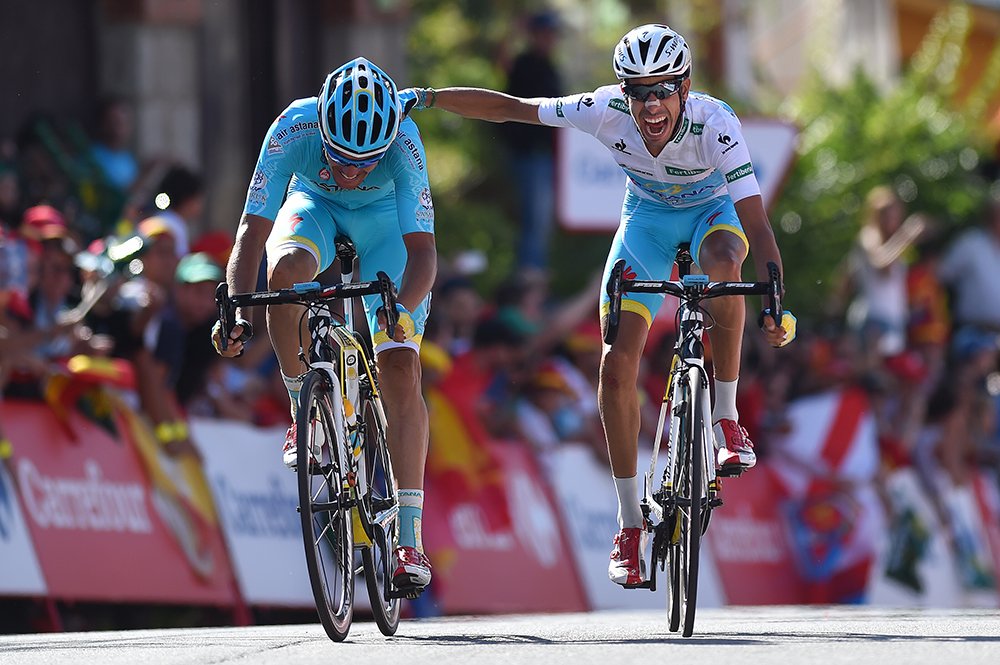
But the “X hour” came on the final section of the third, penultimate climb. The teams’ strategists had undoubtedly marked the gradient of this section in advance, and this is exactly where Astana came alive. First Astana’s Basque Mikel Landa attacked, and the team captain, Italian Fabio Aru, immediately jumped on his wheel. The attack instantly turned the peloton into a group of leaders; Tom needed great effort to get back to the attackers, and as soon as he caught them and rejoined the leaders’ group, Aru himself attacked.

Italy’s Fabio Aru of Kazakh team Astana attacks; behind, Tom Dumoulin in the red jersey is dropped Photo: Tim De Waele/TDWsport.com
At first only Nairo Quintana and Rafał Majka were able to respond to Fabio’s attack

The Sardinian checks what his attack has brought Photo: Tim De Waele/TDWsport.com
As it turned out, this attack and the team strategy mentioned earlier proved decisive for this year’s Vuelta. Fabio kept a 20-second lead to the top of the climb; on the descent Tom tried, for the second time, to close the gap, but meanwhile the attackers were met by teammates sent up the road in the breakaway, and when they went to the front and pulled, it became clear that Astana’s tactical plan had worked brilliantly. From then on the advantage kept growing. Purito, who had jumped across to the breakaway in time, also helped, because the coinciding team interests left Tom Dumoulin without strong allies as well.
The fight for the remaining podium places was also interesting. Here Movistar’s Nairo Quintana tried his hand: the great Colombian attacked, but his main rival, Poland’s Rafał Majka, was ready for such a turn of events
As a result, thanks to his team’s filigree work, Fabio Aru took back the red jersey — this time for good.

Fabio Aru in the Vuelta leader’s red jersey, the flag of Sardinia proudly on his shoulders Photo: Tim De Waele/TDWsport.com
Although on the race’s decisive stage he lost not only the lead but even the podium, and in the end had to settle for sixth place, Tom Dumoulin became the true revelation of the race, and with his character he won the hearts of many fans.

Beaten but not broken: Tom Dumoulin. Respect Photo: Tim De Waele/TDWsport.com
Many felt it would have been better for him to think about his podium chances rather than victory, but Tom chose all or nothing, and this time he lost. Still, I believe many successes await him!
I haven’t said anything about the stage hunters for a long time. Today I can’t pass them by: today, with a long solo breakaway — there were more than 100 kilometers to the finish when he went on his solo attack — veteran Rubén Plaza won his second Grand Tour stage of the year!
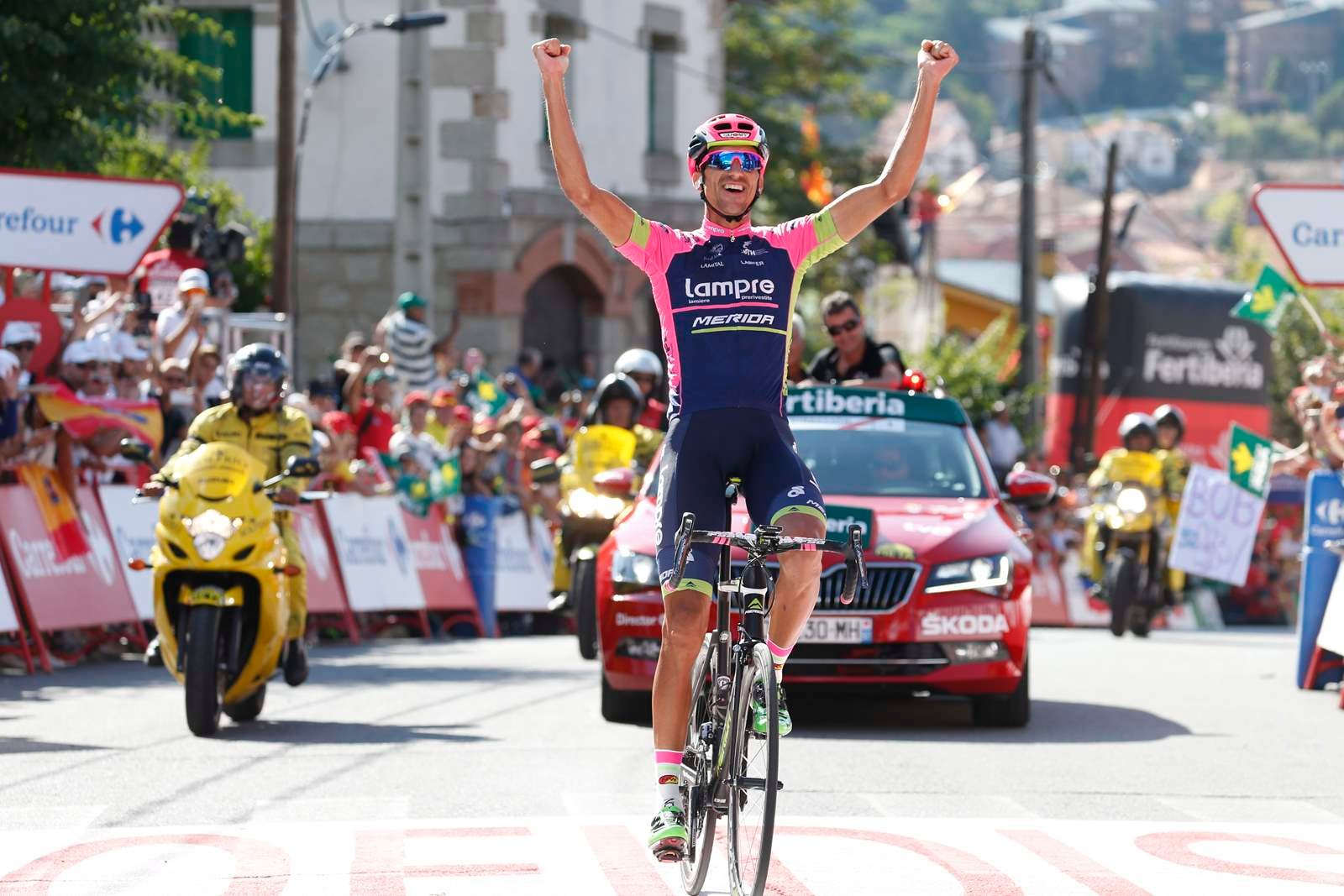
Rubén Plaza at the finish of Vuelta stage 20 Photo : Yuzuru SUNADA
Featured image: Tim De Waele/TDWsport.com
Inside post thumbnail image: stage profile/lavuelta.com
Translated from Georgian with the assistance of Claude (Anthropic), reviewed by the Velorbola editors.

In history, only three riders have won all five Monuments: [...]
April 15, 2019