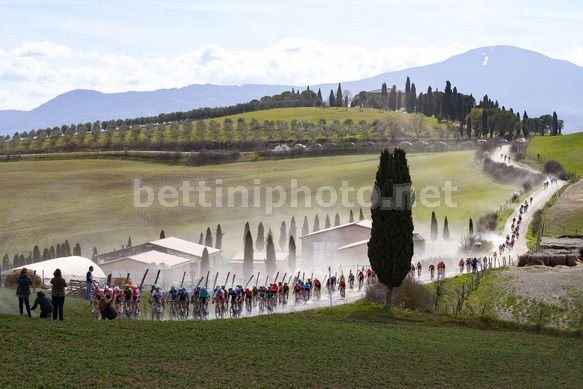
When Giancarlo Brocci, an Italian hopelessly in love with the cycling of bygone days, set out in 1997 to revive the values of a cycling era long consigned to the past, he launched rides for cycling enthusiasts and christened them Eroica. No one imagined that these gatherings — “gran fondos,” in the Italian tradition — would, in a very short time, push open the notoriously heavy gates of the WorldTour.
From the very start, the enthusiasts set their sights on the dirt roads that survive around Siena in Tuscany, and they laid the route across those white climbs and descents — because only there, on those white gravel roads, can a passer-by feel the spirit of the races of the Gino Bartali and Fausto Coppi era.
I will return to Eroica itself, and to gran fondos in general, in more depth another time; for now, I will try to sketch a short history of how the race came to the attention of today’s professionals.
The first Eroicas were held at the turn of September and October — grape-harvest time in Tuscany — which did much to create the festive atmosphere around the event. Add to that the difficulty of the route: it clearly stood out as an Italian version of the famous cobbled Classics of the north, and so it drew more and more attention from the professionals. On October 9, 2007, alongside some two thousand amateurs, they too lined up at the start! At that time the race was given category 1 status on the UCI Europe Tour. It was the only time the event was held on an autumn weekday.
It is worth noting that at that time the title sponsorship of the race was taken on by the world’s oldest operating bank, Monte dei Paschi di Siena (Banca Monte dei Paschi di Siena S.p.A. (MPS)).
The first professional contest, under the name Monte Paschi Eroica, was held over 181 kilometers, 60 of them on white dirt roads. Victory went to Russia’s Alexandr Kolobnev, who thereby entered history forever as the first king of the white roads!
The following year the race was moved to the spring, and the winner was a mega-star of cycling, the legendary Swiss Fabian Cancellara.

Strade Bianche 2016 – Siena – Siena 176 km – 05/03/2016 – Fabian Cancellara (Trek – Segafredo) – foto Luca Bettini/BettiniPhoto©2016
The “Spartacus” factor raised the standing of Strade Bianche to the highest level: he won here three times — in 2008, 2012 and 2016 — a record that still stands today. The grateful Italians duly honored the Swiss rider’s contribution, and on March 3, 2017, the toughest sector, Monte Sante Marie, was named after Fabian Cancellara.
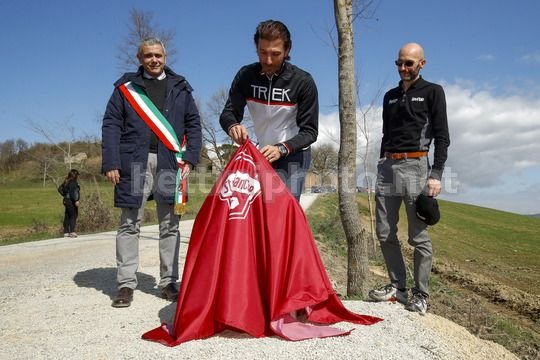
Cancellara’s Sector Milestone Ceremony – 03/03/2017Ê- Mauro Vegni (ITA – RCS Sport) – Paolo Bonari (ITA – Mayor of Aasciano) – photo Luca Bettini/BettiniPhoto©2017

Cancellara’s Sector Milestone Ceremony – 03/03/2017Ê- Fabian Cancellara (SUI) – photo Luca Bettini/BettiniPhoto©2017
The status of Strade Bianche was raised even further by the many stars who shone there — just consider two world champions: the great Pole Michał Kwiatkowski won twice, and the legendary Belgian Philippe Gilbert once.
In the same years, the sense of monumentality was reinforced when a stretch of white roads was included in a stage of the Giro d’Italia. On May 15, 2010, the 217-kilometer seventh stage of the 93rd Giro was held between Carrara and Montalcino. It poured with rain that day, and at the end two legends fought it out: Australia’s Cadel Evans and Kazakhstan’s Alexandre Vinokourov.


And so passed ten years rich in memorable events, both in the race itself and around it.
From 2017, Strade Bianche appeared with a new, top-tier WorldTour status, and I doubt the race will ever be downgraded — after all, it was born to be a monument!
This status has made victory at Strade Bianche a coveted prize for the very best stars of the world peloton. This year we witnessed one of them fulfill a dream!

Strade Bianche 2019 – 13th Edition – Siena – Siena 184 km – 09/03/2019 – Julian Alaphilippe (FRA – Deceuninck – Quick Step) – photo Luca Bettini/BettiniPhoto©2019
In 2019, it was France’s Julian Alaphilippe of Deceuninck–Quick-Step who made the triumphant entry onto Siena’s Piazza del Campo!

Strade Bianche 2019 – 13th Edition – Siena – Siena 184 km – 09/03/2019 – Jakob Fuglsang (DEN – Astana Pro Team) – Julian Alaphilippe (FRA – Deceuninck – Quick Step) – photo Ilario Biondi/BettiniPhoto©2019
The driving force behind the decisive attack was Astana’s Dane Jakob Fuglsang. Julian backed him all the way, and Wout van Aert also fought to the very end. Wout left the last of his strength on the 16% climb of Via Santa Caterina — he ran out of energy and was left behind right there — while Jakob has never been a finisseur. Julian entered Via Banchi di Sotto as the clear favorite and duly crossed the finish line on Piazza del Campo in triumph!
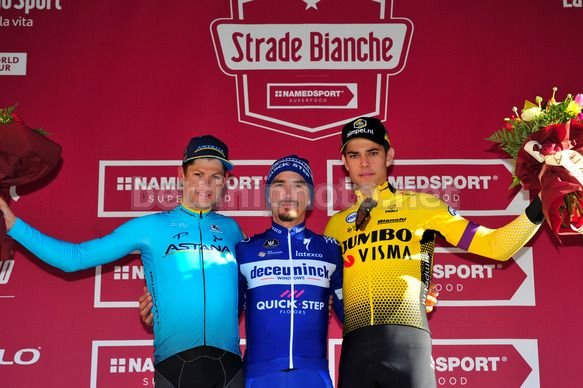
Strade Bianche 2019 – 13th Edition – Siena – Siena 184 km – 09/03/2019 – Julian Alaphilippe (FRA – Deceuninck – Quick Step) – Jakob Fuglsang (DEN – Astana Pro Team) – Wout Van Aert (BEL – Team Jumbo – Visma) – photo Dario Belingheri/BettiniPhoto©2019

Strade Bianche 2019 – 13th Edition – Siena – Siena 184 km – 09/03/2019 – Julian Alaphilippe (FRA – Deceuninck – Quick Step) – photo Dario Belingheri/BettiniPhoto©2019
One fine day I, too, had the chance to stand on Monte Sante Marie, on the sector named after Fabian Cancellara! I couldn’t resist marking the occasion…

Featured image: ROBERTO and LUCA BETTINI/www.bettiniphoto.net
Inside post thumbnail image: ROBERTO and LUCA BETTINI/www.bettiniphoto.net
Special thanks to the Italian photographers ROBERTO and LUCA BETTINI for permission to use their watermarked works in our publications.
Glasgow, Zurich, Kigali and Montreal! Remco Evenepoel has shattered everything [...]
September 22, 2026
The 273-kilometer meat grinder of Montreal became a triumph of [...]
September 28, 2026

When Giancarlo Brocci, an Italian hopelessly in love with the [...]
March 10, 2019