
At the turn of February and March, the main track cycling event of the year — the World Championships — took place at the velodrome in Apeldoorn, the Netherlands.
The world track calendar is tied to the Olympic cycle. Countries and athletes always link their preparation strategy to the next Olympic Games, which is why this factor is the key one in any in-depth look at track battles.
As you know, the next Olympic Games will be held in Tokyo in 2020, so two years earlier the national teams are already completing their generational change, and the main outlines of the Olympic squads are taking shape at the World Championships. You could say this is a watershed period, and not only chronologically: the trial period is already over, and it is already clear whom we may see on the Olympic oval two years from now.
Since I plan to limit myself to a single post about the championships, I will skip the preliminary heats and, in chronological order, focus only on the finals, and — with a few small exceptions — draw your attention only to the statistics. Given its importance, of course, I won’t fail to name the new owners of the world champion’s rainbow jersey. But first, let’s look at the list of events; all of them are held for both women and men, the only difference usually being the distance to be covered. The first five are part of the Olympic program:
Keirin;
Omnium;
Individual sprint;
Team pursuit;
Team sprint;
Time trial;
Individual pursuit;
Points race;
Scratch;
Madison.

Day one — February 28
The championships’ first medals were contested in the women’s scratch race (an individual mass-start race; men race over 15 kilometers and women over 10, and the winner is whoever is first to cover the set distance). The very first race showed the hosts’ extremely high motivation. The race — and the first gold of these championships in the team standings — went to the Netherlands’ Kirsten Wild. It was Kirsten’s second rainbow jersey; she had won her first in the same event in 2015. But as it later turned out, this was only the beginning, and fans will remember these championships as her benefit performance, since Wild won three gold medals here in total. Still, let’s not depart from the course we’ve set and follow things in order.
After the scratch came the team sprint; the women’s and men’s champions were crowned at the end of the first day.
Women’s team sprint podium:
Germany (Miriam Welte, Kristina Vogel, Pauline Grabosch);
Netherlands;
Russian Federation.
Men’s team sprint podium:
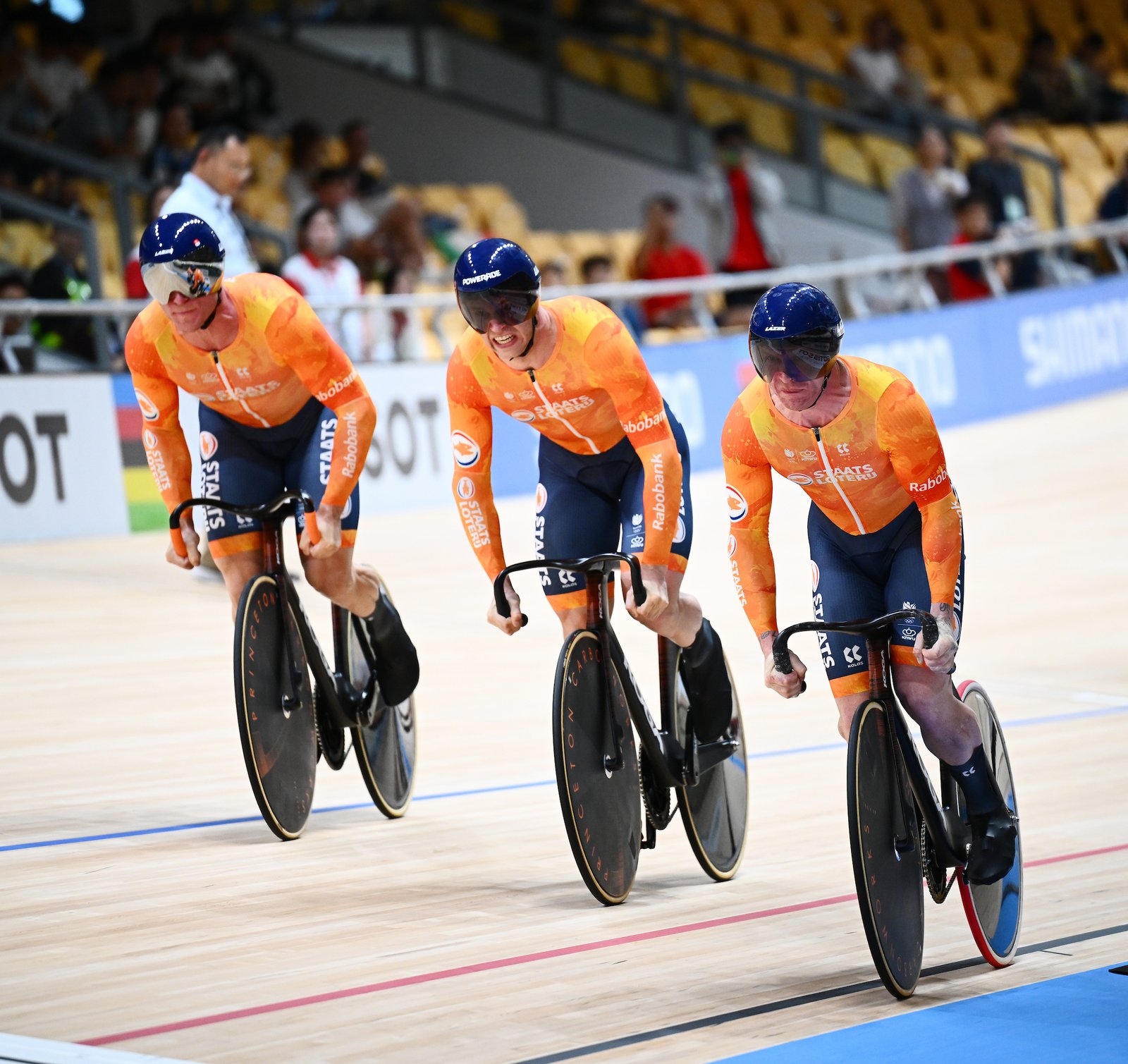
Netherlands (Nils van ‘t Hoenderdaal, Harrie Lavreysen, Jeffrey Hoogland, Matthijs Büchli);
Great Britain;
France.
Day two — March 1
On the second day, medals were awarded in the men’s keirin and scratch race, and in the women’s and men’s team pursuit.
Men’s keirin
Fabián Puerta (Colombia);
Tomoyuki Kawabata (Japan);
Maximilian Levy (Germany).
Men’s scratch race
Yauheni Karaliok (Belarus);
Michele Scartezzini (Italy);
Callum Scotson (Australia).
Women’s team pursuit
USA (Jennifer Valente, Kelly Catlin, Chloé Dygert, Kimberly Geist);
Great Britain;
Italy.
Men’s team pursuit
Great Britain (Ed Clancy, Kian Emadi, Ethan Hayter, Charlie Tanfield);
Denmark;
Italy.
Day three — March 2
Men’s individual pursuit
Filippo Ganna (Italy);
Ivo Oliveira (Portugal);
Alexander Evtushenko (Russian Federation).
Men’s points race
Cameron Meyer (Australia);
Jan-Willem van Schip (Netherlands);
Mark Stewart (Great Britain).
Women’s omnium
Kirsten Wild (Netherlands);
Amalie Dideriksen (Denmark);
Rushlee Buchanan (New Zealand).
Women’s sprint
Kristina Vogel (Germany);
Stephanie Morton (Australia);
Pauline Grabosch (Germany).
Day four — March 3
Men’s omnium
Szymon Sajnok (Poland);
Jan-Willem van Schip (Netherlands);
Simone Consonni (Italy).
Men’s sprint
Matthew Glaetzer (Australia);
Jack Carlin (Great Britain);
Sébastien Vigier (France).
Women’s time trial
Miriam Welte (Germany);
Daria Shmeleva (Russian Federation);
Elis Ligtlee (Netherlands).
Women’s individual pursuit
Chloé Dygert (USA);
Annemiek van Vleuten (Netherlands);
Kelly Catlin (USA).
Women’s madison
Great Britain (Katie Archibald, Emily Nelson);
Netherlands;
Italy.
Day five — March 4
Men’s time trial
Jeffrey Hoogland (Netherlands);
Matthew Glaetzer (Australia);
Theo Bos (Netherlands).
Men’s madison
Germany (Roger Kluge, Theo Reinhardt);
Spain;
Australia.
Women’s keirin
Nicky Degrendele (Belgium);
Lee Wai Sze (Hong Kong);
Simona Krupeckaitė (Lithuania).
Women’s points race
Kirsten Wild (Netherlands);
Jennifer Valente (USA);
Jasmin Duehring (Canada).
In total, at their home championships the Kingdom of the Netherlands won five gold and five silver medals plus two bronze, twice as many medals as second-placed Germany — although if we count rainbow jerseys, the Germans were only one behind the winners of the team standings.

Sadly, in a sport in which 10 sets of medals are contested at the Olympic Games, and in which we once even had a tradition, we don’t even have a proper velodrome in our country — never mind any other “luxuries”…
All images: UCI/www.uci.org/track
Translated from Georgian with the assistance of Claude (Anthropic), reviewed by the Velorbola editors.

In history, only three riders have won all five Monuments: [...]
April 15, 2019